Emei Tea Ceremony
Formation and Development
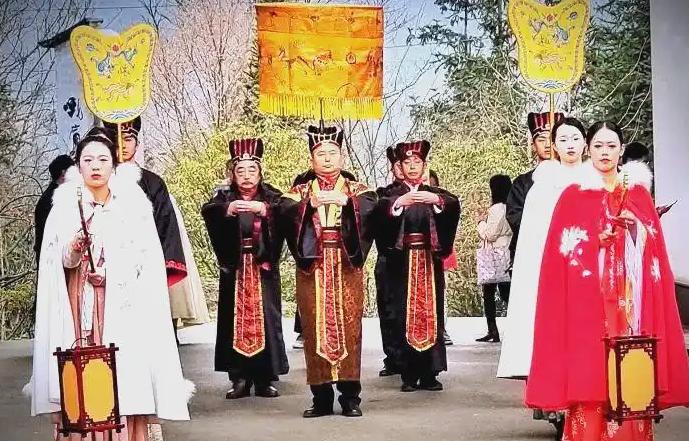
Buddhism was introduced to Mount Emei in the 1st century AD. After nearly 2,000 years of Buddhist development, it has left a rich legacy of Buddhist culture on the mountain, nurtured numerous eminent monks and virtuous masters, and gradually made Mount Emei a renowned Buddhist sacred site with profound influence in China and even the world, as well as one of China's Four Great Buddhist Mountains. As an important part of Bashu Buddhist culture, Buddhism on Mount Emei had already gained influence by the Tang Dynasty. During the Song and Ming dynasties, with the support and imperial grants from successive royal families, Mount Emei evolved into a major center of Buddhism in Sichuan, officially becoming one of China's Four Great Buddhist Mountains and the Taoist site of Samantabhadra Bodhisattva. Gradually, a distinctive Emei Buddhist culture took shape, featuring belief in Samantabhadra and taking Zen as the mainstream. Emei Buddhism holds an important position not only among the Han people but also exerts a significant influence in Tibetan Buddhism. As early as the mid-15th century, the renowned Tibetan Buddhist scholar Zhongqin Kajuoba Namkhai Gyatso led his attendants to Mount Emei to pay homage to Samantabhadra and make vows. According to records, this marked the first visit of a Tibetan Buddhist Living Buddha to Mount Emei. Countless Tibetan compatriots have made pilgrimages to Mount Emei ever since.
As recorded in The Five Lantern Festival Records, starting from the reign of Emperor Wenzong of the Tang Dynasty (827 AD), the Linji and Caodong sects of the Southern School of Chinese Buddhism successively established themselves on Mount Emei. Around 835 AD, monks of the Linji sect on Mount Emei, such as Monk Linkan, integrated Linji Qigong, Emei Tongbi Boxing, and Emei Sword Immortal Arts to create the most complete origin of the "Emei School of Martial Arts." In 845 AD, Chan Master Changfu Dayuan merged the original concepts of Emei medicinal tea, health-preserving classics, and Buddhist Zen enlightenment thoughts to compile The Pure Rules of Emei Tea Ceremony, laying the foundation for the earliest Emei Tea Ceremony.
Origin of Emei Tea Ceremony
The Emei School of Tea Ceremony, with its spiritual essence as the core and soul of tea culture, pursues the highest enjoyment of taste and inner peace. Sichuan is the birthplace of tea, where the world's earliest tea trees were discovered, and Buddhism further promoted the development of tea culture. During the reign of Emperor Xuanzong of the Tang Dynasty, Chan Master Changfu of Mount Emei founded the Emei Tea Ceremony and compiled the tea ceremony rules The Pure Rules of Emei Tea Ceremony. By 880 AD, he had taught the tea method to 62 monks, and in 881 AD, the responsibility of overseeing the tea ceremony rules was handed over to Master Longyuan of Wannian Temple. As a native of Mount Emei, Master Longyuan was proficient in tea planting and production. Through his efforts, the Emei Tea Ceremony incorporated some tea planting and production techniques, and gained the support and practice of a large number of lay disciples. Most people today know that almost all eminent monks of Mount Emei throughout history have grown and produced tea themselves. Famous Chinese teas such as "Zhuyeqing" (Bamboo Leaf Green), "Emei Xueya" (Emei Snow Bud), "Emei Baiya" (Emei White Bud), and "Miaopin" (Wonderful Product) are a series of premium green teas grown and made by eminent monks of Mount Emei over the centuries.
In the autumn of 952 AD, Master Longyuan passed away. More than 200 of his lay disciples traveled to pay their respects to his remains. According to The Single Spirit Name Record, this was the largest gathering of lay disciples paying homage to a famous monk's remains during the Tang Dynasty. In 953 AD, the Emei Tea Ceremony was taken over by Monk Nengming, a former Confucian scholar from Chang'an who had converted to Buddhism on Mount Emei. During the same period, Monk Dazhong and Master Longda also practiced and taught the tea ceremony, but due to numerous Buddhist affairs, their efforts did not last long. In his spare time from Buddhist practice, Monk Nengming, drawing on his understanding of Confucianism, compiled and organized the chronological history of the Emei Tea Ceremony in the style of Confucian historical records for the first time, recording the successive inheritors of the Emei Tea Ceremony and major tea ceremony events. This work was named The Calendar of Emei Tea Methods. In 995 AD, Monk Nengming was posthumously awarded the title "Master Nengming" at the age of 72. In 1016 AD, Master Renkong and Chan Master Shengyun jointly took over the main practice of the Emei Tea Ceremony from Master Nengming. They vigorously advocated for all monks on the mountain to practice the tea method, which facilitated inner Buddhist cultivation and was of great benefit to meditators. This period is regarded as the most prosperous era for tea ceremony activities on Mount Emei, as recorded in many historical books about the mountain.
In 1071 AD, Chan Master Shengyun passed away at the age of 119, making him the oldest person in the history of the Emei Tea Ceremony. In 1080 AD, Master Guowu of Shenshui Pavilion on Mount Emei took over the Emei Tea Ceremony. Originally a dedicated Buddhist monk responsible for civil engineering on Mount Emei, Master Guowu had a deep understanding of the mountain's land and water. The famous health-preserving Yuye Spring (Jade Liquid Spring) was discovered by him, and later, renowned poets such as Su Dongpo and Huang Tingjian left their calligraphy works there. During Master Guowu's tenure, the Emei Tea Ceremony entered a low ebb. Additionally, with the proliferation of various Buddhist sects on Mount Emei, Buddhist disciples were divided into eight more detailed sects from the Northern and Southern Schools, leading to a decline in the number of Emei Tea Ceremony practitioners. Master Guowu was the second leader of the Emei Tea Ceremony to accept a large number of lay disciples. He traveled with his lay disciples to inspect the terrain of Bailong Cave on Mount Emei (now around Bailong Temple on Mount Emei) and eventually reclaimed more than 600 mu (approximately 40 hectares) of land there for tea planting.
Thanks to Master Guowu's efforts, the Emei Tea Ceremony achieved some development but struggled to make significant progress, as most Buddhist monks focused on practicing martial arts and reciting scriptures. It was not until 1140 AD that the warrior monk Monk Guode took over the Emei Tea Ceremony. At the age of less than 22, Guode had no prior experience in practicing the tea method and merely kept records as his main task, finding it difficult to attain a state of tranquility through the teachings of Master Guowu. However, this warrior monk played an indispensable role in the development of the Emei Tea Ceremony. Having practiced martial arts all year round, he was accustomed to movement and often gestured with tea-tasting utensils in the style of martial arts. With his extensive knowledge and experience, Master Guowu instructed Guode to refine these movements into a standardized performance routine. In 1152 AD, a book entirely different from Chan Master Changfu's The Pure Rules of Emei Tea Ceremony, which emphasized tranquility, was born—The Fate of Tea. Focusing on movement as the core of tea ceremony practice, The Fate of Tea integrated many martial arts principles, enhancing its visibility and providing a means of physical and mental relaxation for those seeking tranquility. By 1179 AD, the Emei Tea Ceremony had over 400 disciples, divided into two categories: dynamic and static. For 30 years after the deaths of Master Guowu and Monk Guode, their teachings remained the spiritual backbone of the Emei Tea Ceremony, and no formal successor was appointed. Instead, practitioners learned naturally, forming a series of tea ceremony forms. The main ones included four fundamental tea methods of the Emei Tea Ceremony: Emei Zen Tea, Emei Confucian Tea, Emei Taoist Tea, and Long Pot Tea Ceremony.
In 1222 AD, Monk Changshen took over the affairs of the Emei Tea Ceremony. During his tenure, he received countless literati and scholars who had fled to Mount Emei from Jiangnan to seek refuge. Watching the Emei Tea Ceremony while tasting tea left a deep impression on these literati, who were ranked ninth in the social hierarchy under the political oppression of the Yuan Dynasty. The Buddhist layman Wang Daoju included the entire content of The Fate of Tea from the Emei Tea Ceremony in his work Notes on Tea. Although the famous poet Wu Wenying stayed on Mount Emei for less than a year, he still wrote in his ci poem Mount Tiandao Moon·Climbing Mount Emei and Recalling the Past: "The mountain moon blows cold with the wind past Taibai, the Emei tea method has been cherished since ancient times." Around 1260 AD, Tibetan Buddhism was introduced to Mount Emei, dealing a heavy blow to local Buddhism, and various sects struggled to defend themselves. As Monk Changshen was advanced in years, he was unable to continue promoting the tea ceremony and handed over the responsibility to his junior brother Monk Changxuan. Monk Changxuan barely recruited any new practitioners of the tea ceremony, and in 1311 AD, he passed it on to Master Changyuan. Due to Master Changyuan's high status and prestige, as well as his many monk friends on and off the mountain, the Emei Tea Ceremony experienced a resurgence.
After Master Changyuan's passing in 1373 AD, the Emei Tea Ceremony no longer required a dedicated host. For nearly 300 years, it became an integral part of the daily life of Buddhist practitioners on Mount Emei, rather than a specialized practice. When receiving guests, they naturally used the conventional tea-making methods of the Emei Tea Ceremony to entertain visitors. The most famous example occurred in the first year of the Wanli reign of the Ming Dynasty (1573 AD), when Monk Biechuan traveled to the capital to receive the imperial gift of a purple robe and a golden "Long Live Medal." Monk Biechuan demonstrated the Emei Tea Ceremony to Emperor Wanli (Zhu Yijun) and presented him with Emei Baiya tea. That year, this tea was included in the Ming Dynasty's tribute tea list, and Monk Biechuan was posthumously awarded the title "Chan Master Hongji." The History of the Ming Dynasty records numerous visits by imperial envoys to Mount Emei to confer plaques and bestow gifts on temples. The Ming Dynasty was undoubtedly the most glorious era for Emei tea and the Emei School of Tea Ceremony.
During the Kangxi reign of the Qing Dynasty, when the eminent monk Master Yuanheng of Mount Emei received the imperial plaque "Shanjue Temple" (Temple of Kind Awareness) from Emperor Kangxi, he was at the height of his enthusiasm for the Emei tea method. If there was an inheritor or researcher of the Emei Tea Ceremony during the Qing Dynasty, it was undoubtedly Master Yuanheng. On the basis of the original tea method, he added four procedures: Inquiry into Tea, Sitting in Contemplation, Listening to Sutras, and Appreciating Water, which connected the inherent laws of movement and tranquility in the entire Emei Tea Ceremony. In 1862 AD, Monk Yanyou of Mount Emei compiled three theoretical treatises on the tea affairs and methods of Master Yuanheng from his scattered notes Life Records: Insight into the Tea Method, Enlightenment of the Tea Method, and Cultivation of the Tea Method. These treatises were included in Volume 331 The Six Harmonies Sutra of the complete Zen Canon in 1864. In 1866 AD, Monk Yanyou conducted the most comprehensive chronological research on the Emei Tea Ceremony and included it in his Life Records.
In 1889 AD, Xiangkui, a lay Buddhist at Bailong Cave on Mount Emei, came specifically to practice the tea method. By 1898 AD, he had mastered all the procedures of the Emei Tea Ceremony correctly and obtained permission from Master Zhengyuan, the abbot of Bailong Temple, to promote the Emei Tea Ceremony outside Mount Emei by establishing practice venues. From then on, the Emei Tea Ceremony officially had branches founded by laypeople outside the Buddhist community. Between 1940 and 1949, the future of Chinese Buddhism was uncertain, and most monks watched the national situation with hesitation, having no interest in practicing Buddhism, let alone the tea ceremony. It was not until 1968 AD that the eminent monk Master Yanzhe of Bailong Temple, who had a natural love for tea, took over the management of the Emei Tea Ceremony. In his spare time, he diligently studied and promoted the Emei Tea Ceremony, making friends and accepting disciples extensively. His lay disciples included Kuanming, Kuanzhi, Kuanyun, Kuanqing, Kuanghai, etc., many of whom later became masters in the tea ceremony. Through their further discipleship, renowned contemporary Emei School tea art masters such as Hongchen, Hongxuan, Hongde, and Hongjing emerged. Within the Buddhist community of Mount Emei, Master Kuanling and Master Hongshan are also accomplished tea practitioners trained by Yanzhe.
Over time, due to the differing views of successive monks and laypeople on the Emei Tea Ceremony and the dynamic tea method in The Fate of Tea, multiple versions of the tea ceremony have emerged in the long history, leading to inconsistencies in the pure practice and performance of the Emei Tea Ceremony. Therefore, in the early 1980s, Master Yanzhe led his disciple Monk Kuanqing to conduct extensive research in major scripture depositories and historical sites on and off Mount Emei, tracing its origins and exploring its secrets. Building on the achievements of previous sages, they developed a more systematic set of Emei Tea Ceremony (performance-oriented), consisting of six chapters: Emei Zen Tea, Tai Chi Tea Ceremony, Confucian Tea Art, Air Calligraphy, Emei Taoist Tea Ceremony, and Dragon-Phoenix Tea Art, as well as eleven routines: Three Styles of Tea Inquiry, Thirteen Styles of Tea Fate, Thirteen Styles of Dragon-Ph oenix, Thirty-Three Styles of Sun and Moon, Forty-Four Styles of Flying Immortals, Fifty-Five Styles of Pilgrimage, Sixty-Six Styles of Sacred Land, Seventy-Seven Styles of Heaven and Earth, Eighty-Eight Styles of Peace, Ninety-Nine Styles of the Same Ancestry, and One Hundred and Eight Styles of Prosperity. Additionally, they added three more names of Emei Tea Ceremony inheritors to the chronological records in Monk Yanyou's Life Records. Subsequently, Master Yanzhe elevated the Emei Tea Ceremony to a traditional tea ceremony school and adopted the general name "Emei School" to unify all its various tea methods. In 1985 AD, Master Yanzhe personally inscribed the plaque "Emei School" as a symbol of inheritance.
After Master Yanzhe's passing, Monk Kuanqing entrusted the entire set of rules of the Emei School Tea Ceremony to his disciple Jin Gangshi (Vajra Stone) for inheritance. In 1999 AD, Jin Gangshi officially became the 37th registered inheritor of the Emei Tea Ceremony, responsible for all missionary affairs of the Emei School and the promotion of Emei School tea art performances.
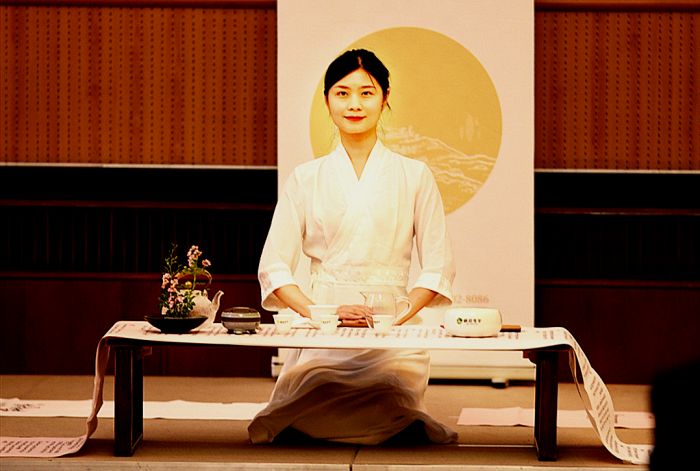
Performances of the Emei Tea Ceremony
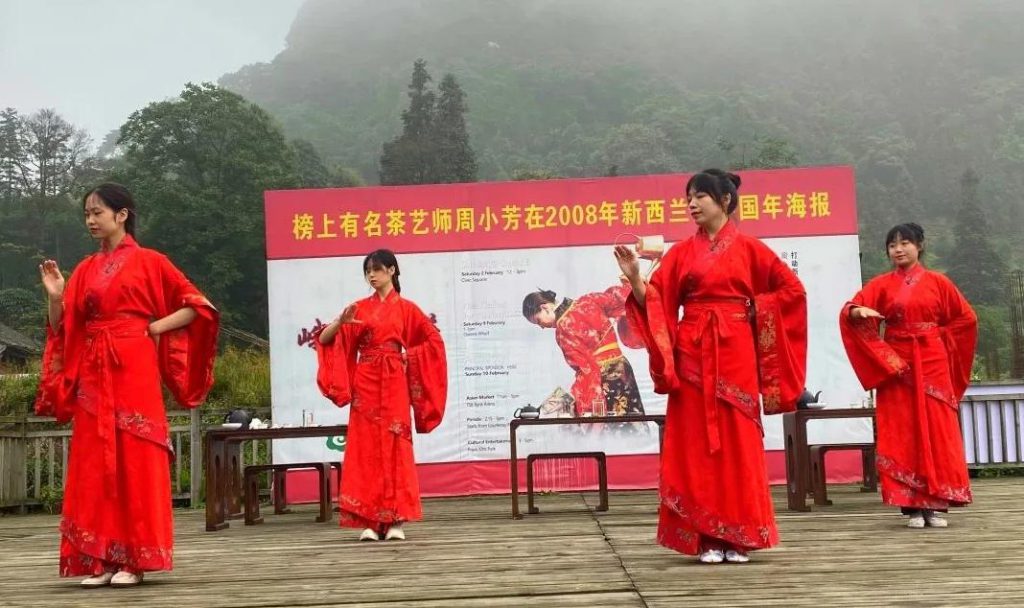
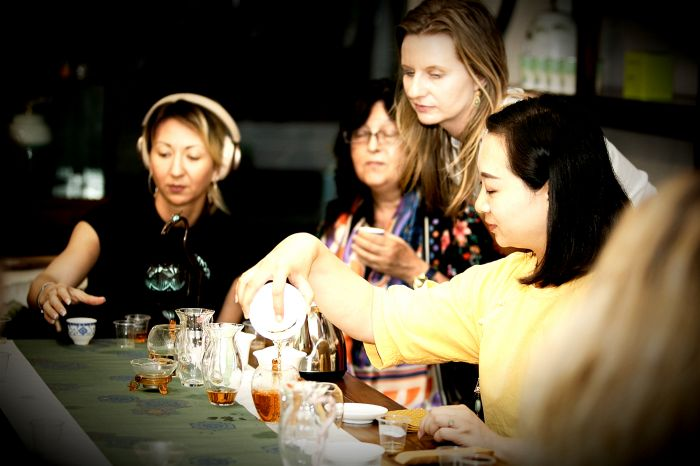
As a school of Chinese Zen tea culture, the Emei Tea Ceremony integrates elements of martial arts and calligraphy, boasting a unique artistic style. Originating from Mount Emei, the Emei Tea Ceremony combines Buddhist Zen philosophy, traditional tea culture, and local natural and humanistic characteristics, emphasizing the "harmony between tea and the mind." It is ranked alongside the Japanese Tea Ceremony and the Korean Tea Ceremony as one of the important tea ceremony schools in East Asia. Below is an introduction to some common performance forms of the Emei Tea Ceremony:
Emei School Air Calligraphy
- Performance Process: The performer holds a teapot in the right hand, places the left hand behind the waist, and enters the stage with a straight step. Upon reaching the center of the stage, they hold the teapot and bow to greet the audience. During the performance, they need to complete 24 consecutive and rapid movements, such as "Single-Minded Focus" and "Two Stars and Eight Constellations." After the performance, they hold the teapot in the right hand, bow to thank the audience, then retreat to the right side of the tea table, pack up props such as tea utensils and tablecloths, hold the tea table flat with both hands, and exit the stage with a bow.
- Features: Known for the "Five Speeds"—fast eyes, fast hands, fast water, fast feet, and fast body—this is recognized in the Chinese tea art performance industry as the most systematic and fastest set of tea methods, with a total duration of approximately 3 minutes. During the performance, the performer maintains intense focus, with infinite changes in hand movements. Water from the teapot flows into the cups at a speed of three meters per second, the feet move quickly to the rhythm of the music, and the body rolls flexibly.
Emei Tea Ceremony Tai Chi Tea Method
- Performance Process: Performers enter the stage in two cross formations of four men and four women. They sequentially complete 15 routine movements, including "Starting Form," "Setting the Scene," "Dividing the Teapot," "Unfolding the Teapot," and "Holding Water." The movements include bent-leg cloud palms, bow-body teapot pushing, and cloud-hand turning. Finally, they lift the teapot, spread their feet apart, stretch their hands flat, draw them back to hold the teapot in front of the chest, and return to the starting form.
- Features: Based on Tai Chi routines and integrated with long pot tea art techniques, this tea method features natural, harmonious, extended, and gentle movements, with rich connotations and pleasing artistic characteristics, showcasing a sense of cosmic space.
In addition, the Emei Tea Ceremony performances include various other forms such as Emei Zen Tea, Confucian Tea Art, Emei Taoist Tea Ceremony, and Dragon-Phoenix Tea Art. Together, these performance forms constitute the rich cultural connotation and unique artistic charm of the Emei Tea Ceremony.