Mount Emei
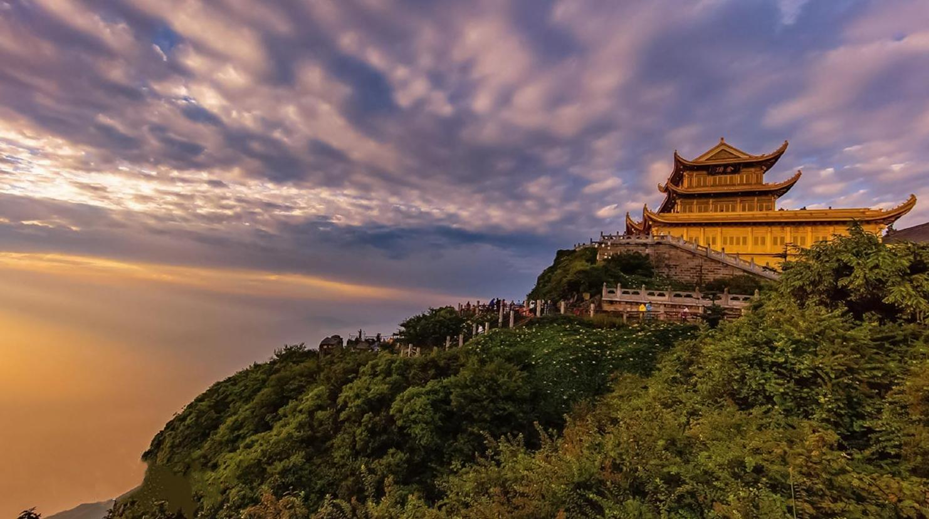
Mount Emei (also written as “峨嵋山” in some historical contexts), a branch of the Qionglai Mountain Range, is located on the southwestern edge of the Sichuan Basin in China. It lies between 29°16′N – 29°43′N latitude and 103°10′E – 103°37′E longitude, rising abruptly from the Emei Plain. The mountain stretches 105 kilometers from north to south. Its main peaks are Da’e Mountain, Er’e Mountain, San’e Mountain, and Si’e Mountain. Among them, Da’e Mountain constitutes the Mount Emei Scenic Area, covering an area of 154 square kilometers. The scenic area features the Golden Summit (the main peak) and Wanfo Summit—the highest peak, with an altitude of 3,099 meters.
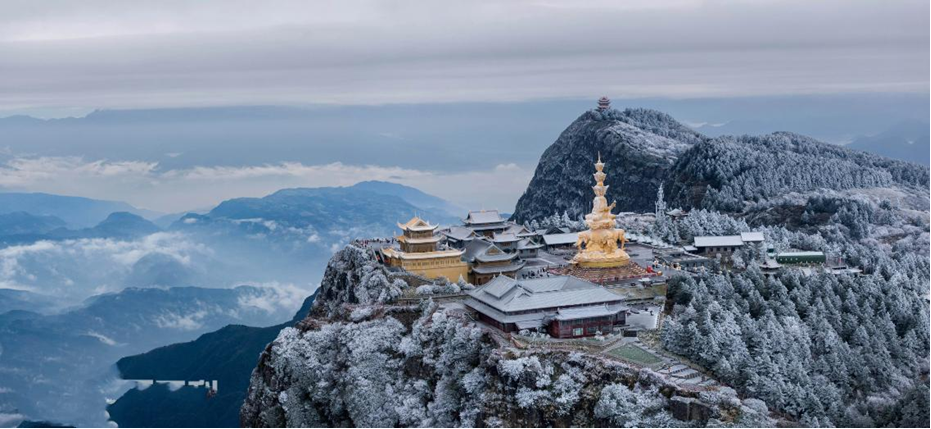
Mount Emei boasts a profound cultural heritage. As a sacred site of Chinese Buddhism, it is known as the “Paradise of the Buddha’s Kingdom” and serves as the dojo of Bodhisattva Samantabhadra. It is ranked among China’s Four Great Buddhist Mountains, enjoying fame both at home and abroad alongside Wutai Mountain (Shanxi), Jiuhua Mountain (Anhui), and Putuo Mountain (Zhejiang). Renowned for its natural landscapes characterized by “grandeur, elegance, divinity, uniqueness, and vitality,” as well as its profound Buddhist culture, Mount Emei was inscribed on UNESCO’s World Heritage List (for both cultural and natural values). The scenic area covers approximately 154 square kilometers and houses around 26 temples. Its cultural richness is further reflected in the thriving development of Buddhism, Taoism, martial arts, and mountain tea culture, with numerous historical figures having left poems here. In 1996, most of Mount Emei’s cultural relics were added to UNESCO’s World Cultural Heritage List.
Climate
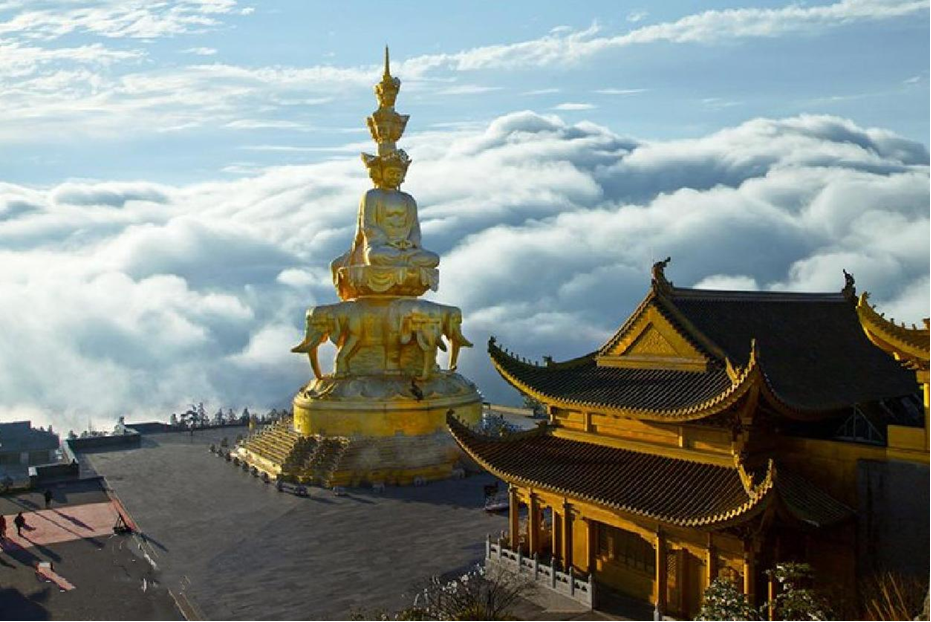
Mount Emei is situated in the subtropical monsoon climate zone of central China. The entire mountain area experiences frequent clouds and fog, low sunshine hours, and abundant rainfall, with significant variations in the distribution of climatic elements.
– The annual average temperature in Emei City (at the foot of the mountain) is 17.2°C.
– At an altitude of 550 meters, the temperature drops to 16.6°C.
– At 800 meters, it is 15.3°C; at 1,000 meters, 14.2°C; at 1,200 meters, 13.1°C; at 1,600 meters, 10.9°C; and at 2,200 meters, 7.6°C.
– At the mountain top (3,000 meters above sea level), the temperature is only 3.0°C.
The relative elevation difference between the mountain top and the city is over 2,600 meters, resulting in a temperature difference of 14.0°C. For every 100-meter increase in altitude, the temperature decreases by approximately 0.5 – 0.6°C.
Affected by the monsoon circulation, the vertical changes in climate on Mount Emei are extremely sharp. Areas above 2,000 meters on Mount Emei are covered in ice and snow for about half a year, with no distinct four seasons—only a distinction between winter and spring. Using the 5-day average temperature as the standard for dividing seasons (10°C for winter, 22°C for summer, and 10 – 22°C for spring and autumn; there are 73 such 5-day periods in a year), areas above 1,600 meters on Mount Emei only have winter, spring, or a combined spring-autumn season throughout the year, with no summer or autumn.
The geological foundation of Mount Emei’s main body is a north-south trending short anticline, surrounded by faults, forming a “folded fault-block mountain.” On its southeast side lies the Emei Thrust Fault, which intersects the Emei Anticline at an angle and has a large fault displacement. The three peaks of the Golden Summit are a monoclinal mountain (with a steep eastern slope and gentle western slope) on the western limb of the Emei Anticline. They were formed by the significant uplift along the Emei Main Fault, followed by long-term gravitational collapse and intense fluvial erosion. The top of this monoclinal mountain is composed of Late Permian Emei Basalt, which has strong erosion resistance; the overlying rock layers (several kilometers thick) have been eroded away. Under the combined effects of erosion and collapse, a reverse slope was formed on the eastern side of the monoclinal mountain—known as the “Sheshen Cliff,” a huge cliff nearly 800 meters high and about 20 kilometers long.
Plant Resources
Mount Emei is home to over 3,200 species of higher plants belonging to 242 families. This accounts for approximately one-tenth of China’s total plant species and one-third of Sichuan’s total plant species.
– There are more than 320 plant species endemic to Mount Emei or China, making up 10% of the mountain’s total plant species—higher than the national average. Over 100 plant species are unique to Mount Emei or were first discovered here and named with “Emei” in their scientific names.
– There are 1,645 species of medicinal plants, including 1,612 species of vascular medicinal plants.
– There are 436 species of ornamental plants, mainly including 25 species (and 5 varieties) from the Ericaceae family and over 20 species from the Aceraceae family.
– There are approximately 100 – 120 species of fruit-bearing plants, primarily from genera such as Rubus, Ribes, Rosa, Actinidia, Elaeagnus, and Cornus.
– Aromatic plants on Mount Emei mainly come from families such as Magnoliaceae, Lauraceae, Rosaceae, Lamiaceae, Apiaceae, Asteraceae, Araceae (genus Acorus), Orchidaceae (genus Cymbidium), and Zingiberaceae (genus Zingiber), with the Lauraceae family alone having 48 species across 11 genera.
– Fiber plants are distributed across more than 40 families on the mountain.
Golden Summit and Golden Buddha
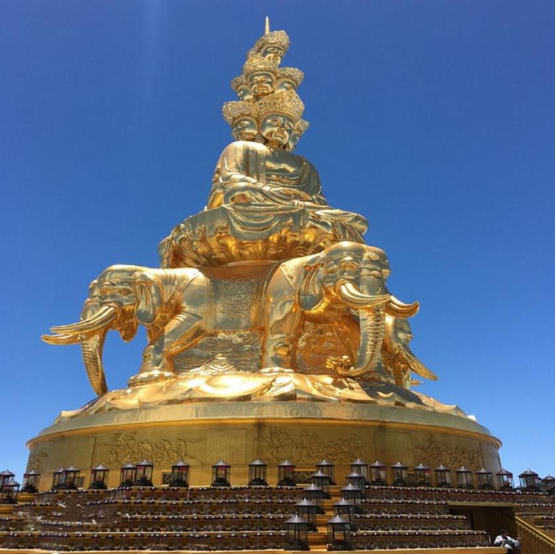
The Golden Summit is the symbol of Mount Emei, and the Golden Buddha is its iconic landmark. A 48-meter-tall golden statue of Samantabhadra (with four faces and facing ten directions) stands atop the Golden Summit. It is believed to gather the spiritual energy of heaven and earth, reflect the radiance of the sun and moon, overlook the various aspects of the mortal world, and fulfill the wishes of all living beings.
The elegant and graceful Samantabhadra sits on a platform adorned with white elephants and lotus flowers, appearing calm, compassionate, and serene. Clouds and mist swirl around the Buddha statue. When the sun’s rays shine on the treasure top of the statue, countless rays of auspicious light reflect off the Golden Buddha, inlaying the sea of clouds with a magnificent golden border. This sight deeply touches the hearts of all beings, prompting devout believers to kneel, look up, and pay their respects.
Xixiangchi (Elephant-Washing Pond)
Xixiangchi is one of the national key temples announced by the State Council in 1983. Located on Zuantian Slope at an altitude of 2,070 meters on Mount Emei, it is 25 Chinese miles (about 12.5 kilometers) uphill from Xianfeng Temple.
During the Ming Dynasty, it was only a pavilion called “Chuxi Pavilion” (Pavilion of First Joy), which was later converted into a nunnery named “Chuxi An” (Nunnery of First Joy). According to legend, when Bodhisattva Samantabhadra passed by on his elephant, the white elephant bathed in the pond—hence the name was changed to “Xixiangchi” (Elephant-Washing Pond), also known as “Tianhua Chan Yuan” (Tianhua Zen Monastery). The current complex includes the Maitreya Hall, the Main Buddha Hall, the Guanyin Hall, a scripture-storing building, and guest quarters.
Leidongping (Thunder Cave Flat)
Leidongping is located on Lianwang Slope at an altitude of 2,430 meters. During the Song Dynasty, there was a Leidong Shrine (Thunder Cave Shrine), which was rebuilt by the Mount Emei Buddhist Association in 1992.
In the center of the first floor of the temple stands a statue of Maitreya Buddha, with a simple and solemn design. To the right of the temple is a pavilion called “Leidong Ting” (Thunder Cave Pavilion). Legend has it that there are 72 caves under the rocks of Leidongping, where dragon gods and thunder gods reside. In ancient times, when there was a drought, local villagers would come here to pray for rain.
In the past, an iron stele was erected beside the temple, prohibiting visitors from making loud noises—otherwise, thunder, lightning, and violent storms would break out. Between the steep cliffs to the right of the temple, there are legendary caves such as the “Feilai Jian Dong” (Flying Sword Cave, also known as Immortal Sword Cave) where Nüwa smelted stones, the “Fuxi Dong” (Fuxi Cave) where Fuxi attained enlightenment, and the “Guigu Dong” (Guiguzi Cave) where Guiguzi wrote books. These caves are shrouded in clouds and mist, rarely visited by humans.
Mountain Tea Culture
In the over 4,000-year history of civilization on Mount Emei (as recorded in written texts), the history of Emei Mountain tea and its tea culture have occupied a significant position. Together with the cultures of Taoism, Buddhism, Confucianism, and Emei-style martial arts on Mount Emei, they form the grand cultural landscape of the mountain.
According to verifiable classical documents, the history of Emei Mountain tea (i.e., tea-related activities) can be traced back to the primitive agricultural period when the Emei region first emerged—approximately 300 years ago. The first people to select and drink wild ancient tea from the forests of Mount Emei were the pioneers of China’s original Taoism, who flocked to the mountain in search of practices for longevity during the ancient agricultural era.
The Emei School of Tea Ceremony was founded in the 5th year of the Huichang era of the Tang Dynasty (845 AD) by Chan Master Changfu of Mount Emei (a native of present-day Meishan). He compiled a tea ceremony manual titled Emei Tea Ceremony: Patriarchal Rules of Purity. By the 1st year of the Guangming era of the Tang Dynasty (880 AD), he had taught the tea ceremony to 62 monks. In the 2nd year of the Guangming era (881 AD), the management of the tea ceremony’s rules was handed over to Master Longyuan of Wannian Temple. The spirit of the Emei Tea Ceremony is “Wisdom and Beauty,” which does not adhere to traditional standards as the sole criterion.